
Strohecker, David Paul. 2018. “Re-Inscribing Subculture: Commodification and Boundary Work in American Traditional Tattooing,” University of Maryland Digital Repository (DRUM).
Strohecker, David Paul. 2018. “Lifestyle Consumption,” In G. Ritzer (ed.), Wiley-Blackwell Encyclopedia of Sociology, Vol. 2.
Strohecker, David Paul. 2014. “Book Review: Covered in Ink: Tattoos, Women, and the Politics of the Body by Beverly Yuen Thompson,” Gender & Society, 31(3).
Strohecker, David Paul. 2011. “Towards a Pro-Social Conception of Tattooing: The Psychological Benefits of Contemporary Body Modification,” Rutgers Journal of Sociology, 1(1):10-36.
Strohecker, David Paul. 2009. “Voter Perception in the 2008 Presidential Election,” published in Explorations: Undergraduate Research Journal, Texas A&M University: 1(1):10-14.
My research interests lie at the intersection of consumer culture and identity, with an eye towards deviant subcultures. Specifically, I look at how individuals create meaning for their lives through the use of market commodities, brands, and other lifestyle signifiers. I am interested in how subculturalists create and maintain community in the face of widespread popular incorporation. I am committed to high caliber scholarship, primarily in the form of qualitative inquiry—longterm participant-observational studies and interviews—and seek further investigation into phenomena like stigma, the construction of value, identity work, resistance, and cultural change.
The corpus of my work has focused on consumer culture, commodification, identity, stigma and stigma management, subcultures, style, taste and status, boundary work, critical theory, and public sociology.
Although trained in survey methodology, I primarily employ qualitative methods, including longterm ethnographic studies, interviews, and focus groups. Most recently I conducted a ten-year auto-ethnographic study of the world of American traditional tattooing.
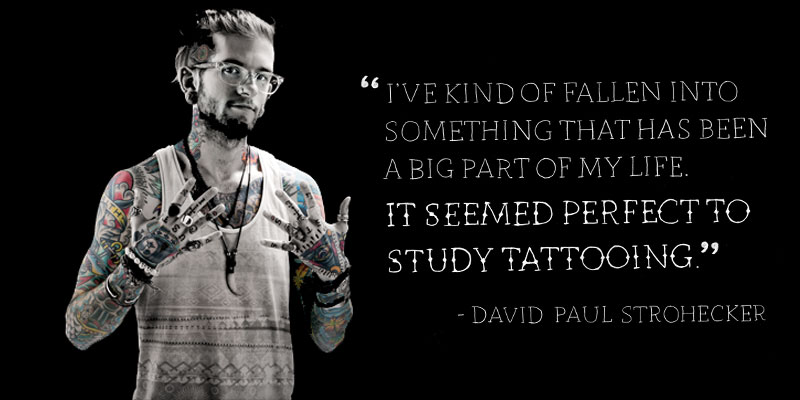
My ongoing research questions include:
- How can we describe elective social formations in the postmodern era?
- What is commodification? What does it mean for culture?
- What is the relationship between identity and consumer culture?
- How are social and symbolic boundaries drawn, enforced, and changed?
I address these four questions by looking at how identity projects operate in the postmodern era. Today’s identities are born out of lifestyles, an important element of consumer culture. Lifestyles are symbolically embellished ways of living. They are inherently cultural and expressive. Style has become the public face of contemporary social identities. But style is rooted in the notion of symbolic boundaries. Symbolic boundaries are differences in meaning. And symbolic boundaries are the basis of institutionalized differences, or, social boundaries. So in my work I investigate how individuals construct and enforce who they as part of a much larger social fabric.
 David Paul Strohecker, PhD